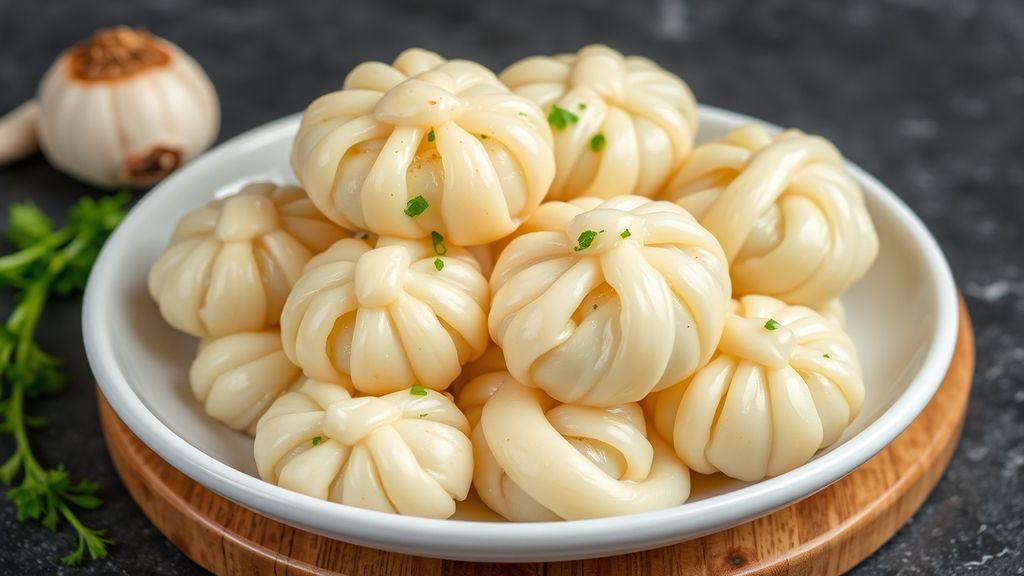

Perfect Garlic Knots: 5-Step Soft, Chewy Recipe
Garlic Knots deliver warm, buttery comfort with a crisp exterior and a pillowy interior. This five-step workflow—mix, knead, rise, shape, finish—focuses on controllable variables so home bakes match pizzeria texture.
- Introduction: Origin and Why Technique Matters
- Ingredients for 12 Garlic Knots (Metric & Imperial)
- Preparation Method — Five Precise Steps
- Nutritional Information per Serving (1 Garlic Knot)
- Expert Pro-Tips to Elevate Your Garlic Knots
- Conclusion: Building Consistency Through Measurement and Practice
- FAQ — Frequently Asked Questions about Garlic Knots
- Key takeaway: A consistent 5-step process yields reliably soft, chewy garlic knots.
- Timing guide: Benchmarks for yeast activation, rises, shaping, proofing, and bake times standardize results.
- Flavor boost: Bloom garlic briefly in butter after baking to maximize aroma and avoid sogginess.
- Pro tools: Digital scale, bench scraper, instant-read thermometer, and a baking stone improve consistency.
Introduction: Origin and Why Technique Matters
Garlic knots trace to Italian-American pizzerias where leftover pizza dough became tied individual breads. The knot shape increases exposed surface area so each bite delivers a concentrated garlicky crust and a tender crumb.
Control of basic variables—flour protein, hydration, yeast activity, and finishing technique—determines chew and oven spring. Learn the functional role of yeast and gluten to tune fermentation and dough strength for consistent results.
Ingredients for 12 Garlic Knots (Metric & Imperial)
Scaling by weight yields predictable dough behavior. Base yield: 12 knots. Baker’s percentages assume flour = 100% (375 g).
Ingredients below include metric, imperial, and baker’s percentages so you can tweak protein and hydration easily. We list dry and wet ingredients separately to clarify mixing order and function.
Dry ingredients
- All-purpose flour: 375 g (3 cups) — 100% (option: use 00 or bread flour for more chew)
- Instant yeast: 7 g (1 packet / 2 1/4 tsp) — 1.9%
- Fine sea salt: 9 g (1 1/2 tsp) — 2.4%
- Granulated sugar: 10 g (2 tsp) — 2.7% (feeds yeast, improves browning)
Wet ingredients & finish
- Warm water (38–43°C / 100–110°F): 240 g (1 cup) — 64% hydration
- Olive oil (in dough): 30 g (2 tbsp) — 8%
- Olive oil for surface: 15 g (1 tbsp) — optional
- Unsalted butter (finish): 56 g (4 tbsp)
- Fresh garlic: 18 g (about 4 cloves), minced or grated
- Fresh parsley: 8 g (2 tbsp), finely chopped
- Grated Parmesan (optional): 30 g (1/2 cup)
- Coarse sea salt or flaky finishing salt: to taste
Preparation Method — Five Precise Steps
This method uses a short, controlled fermentation to get chew without a very long bulk proof. Times assume a typical kitchen at 20–25°C (68–77°F).
Adjust water, flour type, and times if your kitchen sits warmer or cooler. Use an instant-read thermometer to track finished dough temperature rather than guessing; that gives reproducible outcomes.
Step 1 — Activate and Mix
Whisk warm water, sugar, and yeast; wait 2–3 minutes for faint foam. Add olive oil, then stir in flour and salt until a shaggy mass forms.
Chef note: Pre-dissolving yeast with a little sugar gives a quick viability check. If foam doesn’t appear in five minutes, test with a fresh packet before proceeding.
Step 2 — Knead and First Rise
Knead 6–8 minutes by hand or 4–5 minutes in a stand mixer with a dough hook until the dough is smooth and slightly tacky. Perform a windowpane test to confirm gluten development.
Place dough in a lightly oiled bowl, cover, and let rise 45–60 minutes until nearly doubled. Aim for a finished dough temperature of 24–26°C (75–79°F) for optimal enzyme activity and gas retention.
Step 3 — Divide and Shape
Turn dough onto a lightly floured surface and divide into 12 pieces (~48–52 g each). Roll each into a 12–15 cm (5–6 in) rope, tie a simple knot, and tuck the ends underneath for a tidy profile.
Arrange knots on a parchment-lined tray with ~3 cm (1 in) spacing. Cover and proof 20–30 minutes until slightly puffed but not fully doubled to preserve oven spring.
Step 4 — Bake and Monitor
Preheat oven to 230°C (450°F) with a baking stone or heavy tray inside. If you use steam, place a small metal pan on the oven floor during preheat.
Bake 10–12 minutes until golden. Target an internal temperature of 93–96°C (200–205°F) for a fully set crumb. Brushing with oil before baking promotes a slightly crisper crust.
Step 5 — Finish with Garlic-Butter
Melt butter gently, add minced garlic and warm 30–45 seconds to bloom aromatics—do not brown. Remove from heat, stir in chopped parsley, then brush knots liberally.
Sprinkle with grated Parmesan and flaky salt if desired. For deeper garlic flavor with less moisture, use a roasted garlic purée instead of raw minced garlic. Integrate fresh garlic carefully to avoid soggy pockets.
Nutritional Information per Serving (1 Garlic Knot)
Estimated values for one of twelve knots using all-purpose flour and full-fat butter. Values change with substitutions and portioning.
Weigh finished portions for precise tracking and use a nutrition database or app to compute exact numbers for your specific ingredients.
- Calories: 150 kcal
- Carbohydrates: 18 g
- Fat: 7 g
- Saturated fat: 3.5 g
- Protein: 3 g
- Sodium: 180 mg (variable based on finishing salt)
- Fiber: 0.8 g
Expert Pro-Tips to Elevate Your Garlic Knots
Small technical changes yield large improvements. Use higher-protein flour for chew, or enrich with milk powder for a softer crumb.
Hydration tuning: increasing water by 10–20 g opens the crumb but needs gentler shaping. For oil choices, consider olive oil characteristics when selecting an oil for dough and finish and refer to quality comparisons for olive oil.
Freeze-ahead method: par-bake 5–6 minutes until set but not browned, cool, freeze until solid, then reheat from frozen at 180°C (350°F) and finish with hot garlic-butter. For fundamentals on heat and structure refer to baking principles.
Pairings: serve with strained marinara, herbed ricotta, or a lemony aioli to cut richness. Brush with fresh herbs at service for aromatic lift and visual brightness.
Conclusion: Building Consistency Through Measurement and Practice
Reproducible, restaurant-style garlic knots result from controlling flour selection, hydration, yeast health, dough temperature, and finishing technique. Track each variable so you can correlate small changes to final texture.
After a few bakes you will internalize how adjustments affect chew and flavor. Use a scale and thermometer for consistent outcomes and keep a log of times and temperatures for repeatable success.
FAQ — Frequently Asked Questions about Garlic Knots
Below are short, direct answers to common troubleshooting and technique questions. Each entry focuses on actionable fixes and clear alternatives.
If you need deeper explanation on any reply, test the change on a small batch to observe results before scaling up.
Are garlic knots the same as garlic bread?
No. Garlic knots are individual, tied pieces of yeast-leavened dough; garlic bread typically uses sliced loaf or baguette brushed with garlic butter. The crumb, shaping, and bake method differ substantially.
How should I store and reheat garlic knots?
Store cooled knots in an airtight container at room temperature up to 48 hours, or freeze up to three months. Reheat at 180°C (350°F): 6–10 minutes from thawed, 10–12 minutes from frozen, then brush with garlic-butter.
Can I make garlic knots without yeast?
Yeast gives characteristic chew and fermentation flavor. Quick-bread versions using baking powder are possible, but texture and taste will differ from yeast-leavened knots.
Why are my garlic knots dense?
Common causes: inactive yeast, under-kneading (insufficient gluten), short first rise, tight shaping, or cool dough temperature. Verify yeast vitality and aim for a proper windowpane before shaping.
How can I intensify garlic flavor without sogginess?
Bloom garlic briefly in warm butter after baking to deliver aroma without adding moisture to raw dough. For concentrated flavor with less moisture, substitute roasted garlic purée.
See also: internal resources on dough handling and shaping.
See also: Garlic Knots