
Crafting Homemade Chicken Jerky: A Step-by-Step Guide
Homemade chicken jerky delivers a high-protein snack with clean ingredients and controllable flavor. Many cooks prefer making jerky at home to avoid preservatives and to customize texture and spice levels.
- Quick overview: lean chicken, a balanced marinade, and controlled low-heat drying.
- Safety first: hold internal temperatures and dry properly to prevent spoilage.
- Texture control: slice thin for tender jerky or slightly thicker for chew.
- Storage: airtight containers or vacuum-seal for best shelf life.
Overview and Key Concepts
Chicken is a lean protein that dries predictably when prepared correctly. For background on the ingredient, see chicken.
Jerky is a preserved, dried meat product that relies on moisture reduction and salt for safety. For context on the product type, read about jerky.
Prep and Cook Time
Plan roughly 8 to 14 hours total from trimming to cooled jerky. Prep and marinade time affects how deeply flavors penetrate the meat.
Typical breakdown: 30 minutes active prep, 4–8 hours marinating, and 4–6 hours drying depending on thickness and method. Use a timer and thermometer for consistent results.
- Preparation: 30 minutes (plus 4–8 hours marinating)
- Drying: 4–6 hours depending on thickness and method
- Total Time: 8–14 hours
Yield
A typical 2 lb (900 g) batch of chicken breast yields about 20–30 jerky strips, depending on slice thickness. Expect roughly 4–6 snack servings from that yield.
Yield varies with trimming and moisture loss. Weighing the end product helps when you repeat recipes and track nutrition.
Difficulty Level
Making chicken jerky rates as medium difficulty: you need steady knife skills and attention during drying. Temperature control and sanitation are the most technical parts.
However, a dehydrator or a low-heat oven simplifies the process. Beginners can achieve reliable results by following stepwise instructions and measuring times.
Ingredients
Use lean, skinless chicken breast for a consistent texture and predictable drying time. Trim fat to minimize rancidity and uneven drying.
Simple ingredient list with flexible swaps for allergy or flavor needs. For marinating science, see marinade.
- 2 lb skinless, boneless chicken breast (trimmed, thinly sliced against the grain)
- 1/4 cup low-sodium soy sauce
- 2 tbsp honey
- 1 tbsp apple cider vinegar
- 1 tsp smoked paprika
- 1/2 tsp garlic powder
- 1/2 tsp onion powder
- 1/4 tsp black pepper
- 1/8 tsp cayenne pepper (optional)
- Cooking spray or parchment for trays
Instructions
This section breaks the process into precise steps so you can repeat results. Follow the sequence: select, slice, marinate, drain, dry, cool, store.
Keep tools and surfaces sanitized throughout to prevent cross-contamination. Use separate cutting boards for raw poultry.
Slicing and Preparing
Partially freeze the chicken for 20–30 minutes to firm it up for cleaner slices. Cut against the grain into 1/8″–1/4″ strips for ideal chew.
Uniform thickness gives even drying and consistent texture. Trim all visible fat and connective tissue to reduce spoilage risk.
Marinating
Combine soy sauce, honey, apple cider vinegar, smoked paprika, garlic powder, onion powder, black pepper, and optional cayenne. Whisk until emulsified and balanced between sweet, salty, and tangy notes.
Submerge strips and refrigerate 4–8 hours. Turn the meat periodically so every strip soaks evenly and the flavors penetrate.
Drying and Testing
Pat the strips dry before placing them on dehydrator trays or oven racks to reduce surface moisture. Arrange strips in a single layer with gaps for airflow.
Use 160°F (71°C) in a dehydrator or oven on the lowest setting with the door cracked open for ventilation. Rotate trays and test by bending: jerky should bend and crack but not snap.
Tips for Success
Slice consistently, monitor temperature, and test texture rather than relying only on time. Small adjustments to thickness change drying time significantly.
Flavor variations work well: replace soy sauce with tamari for a gluten-free option, add maple for sweetness, or use liquid smoke to boost smoke character.
Also, keep spare parchment and a reliable instant-read thermometer close at hand. Organized setup reduces mistakes and improves repeatability.
Storage and Shelf Life
Cool jerky fully on a wire rack before sealing. Warm or moist jerky seals poorly and invites condensation inside the container.
Store in an airtight container, resealable bag, or vacuum-sealed pack to extend shelf life. Refrigerate for weeks or freeze for months to preserve freshness.
For long trips, use oxygen-absorbing packets with vacuum-sealed jerky to prolong quality. Keep portions small for quick snacking and minimal exposure.
Serving Suggestions
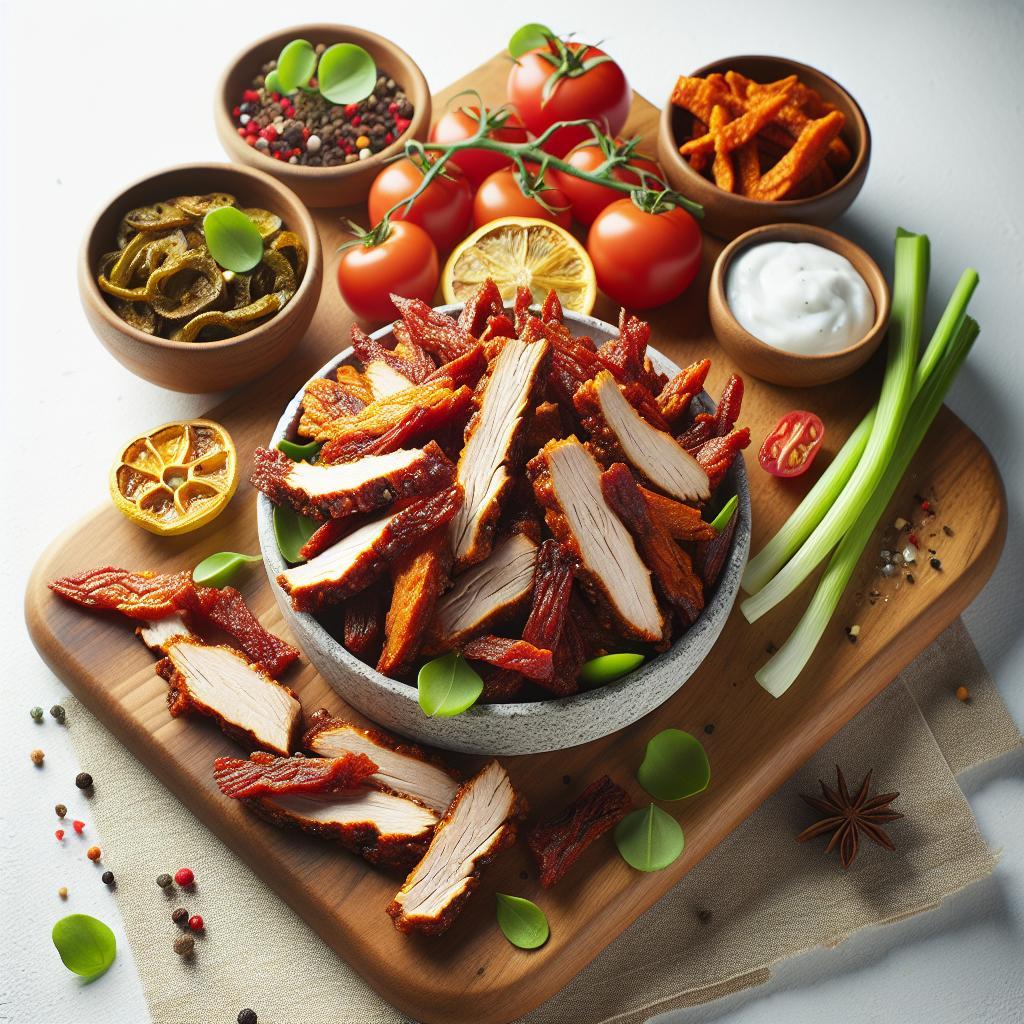
Serve jerky with crisp vegetable sticks, spicy mustard, or as a protein element on a snack board. It pairs well with pickles and nuts for contrast.
Jerky works great for hikers and athletes; pack in a lightweight container or vacuum-sealed bag to protect texture. For party platters, slice into bite-size pieces and garnish with chives.
Nutrition
Chicken jerky is high in protein and low in fat when made from lean breast. Watch sodium in the marinade if you limit salt.
Per-serving nutrition varies by recipe and strip size. Below is an approximate estimate for a single snack portion.
| Nutrient | Per Serving (approx.) |
|---|---|
| Calories | 90 kcal |
| Protein | 18 g |
| Carbohydrates | 2 g |
| Fat | 1 g |
Safety Notes and Best Practices
Food safety relies on temperature control, sanitation, and moisture reduction. For broader principles, consult the general guidance on food safety.
Always use clean utensils, wash hands, and keep raw poultry separate. If you have immune concerns, cook the strips to a safe internal temperature before drying as an extra precaution.
In Retrospect
Crafting homemade chicken jerky rewards precision and experimentation. Over time you will refine slices, marinade balance, and drying times to match your ideal chew and flavor.
Document each batch and adjust variables methodically. That approach turns trial-and-error into reliable, reproducible results and better snacking.
FAQ
Q1: Can I use dark meat for chicken jerky?
A: Yes, but dark meat contains more fat and can shorten shelf life. Trim visible fat and consume sooner or freeze for longer storage.
Q2: How do I test doneness without a dehydrator?
A: Use an oven on the lowest setting with the door propped open a crack for air circulation. Check every two hours and use the bend test: jerky should be pliable and crack but not shatter.
Q3: Is it safe to marinate overnight?
A: Marinating overnight enhances flavor and tenderization. Always keep the meat refrigerated during marination and discard any used marinade that has contacted raw meat.
Q4: How long will homemade chicken jerky last?
A: At room temperature in an airtight container, it lasts up to 1–2 weeks. Refrigerated, it can keep for up to a month; frozen, up to 3 months for best quality.
Q5: What are vegetarian jerky alternatives?
A: Jackfruit, mushroom caps, and soy-based protein slices make excellent plant-based jerky when seasoned and dried similarly. Each base has unique texture and absorption characteristics.
For more on drying as a preservation technique, see food drying.
See also: Chicken Jerky