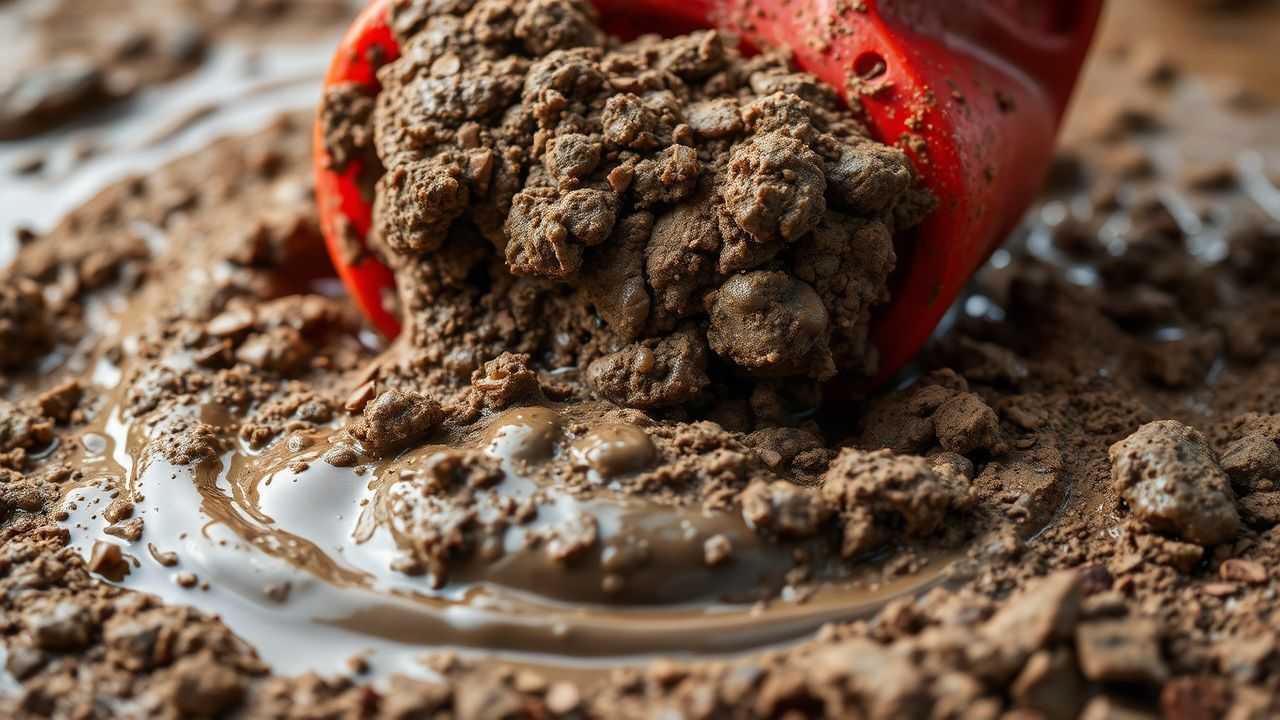

Slurry sits at the intersection of particle science and fluid mechanics. It pairs solid particles with a liquid phase to form a transportable suspension used across mining, construction, and agriculture.
- At a glance: slurry behavior depends on particle size, concentration, and fluid rheology.
- Practical impact: small formulation changes alter pumpability and wear on equipment.
- Measurement matters: viscosity and particle-size analytics guide repeatable mixing.
- Safety & storage: control pH, microbial growth, and sedimentation to preserve quality.
Overview: What defines a slurry
Slurry describes a concentrated mixture of solid particles suspended in a liquid carrier. Engineers treat slurry as a two-phase system where particle interactions, concentration, and carrier properties determine bulk behavior.
Practically, slurry behaves between a liquid and a soft solid. This dual nature creates operational challenges and gives engineers leverage to tune flow using additives and process control.
Key physical properties and rheology
Rheology governs how slurry flows under stress; it sets design parameters for pumping and pipeline sizing. For technical reference on material flow and deformation, see rheology.
Viscosity and yield stress control whether a slurry acts like a viscous liquid or a material with a finite resistance to start flowing. For definitions and units, consult viscosity.
Particle size distribution and suspension mechanics
Particle size dictates settling rate and surface area for particle–fluid interactions. Fine particles increase apparent viscosity and promote stability, while coarse particles settle rapidly under gravity.
Analytical techniques such as laser diffraction and sieve analysis quantify the size distribution that designers use to predict transport behavior and required additive dosages.
Composition: common solids, fluids, and additives
Typical solid phases include clays, mineral fines, and crushed ore. For example, kaolin clay appears frequently in lab recipes and industrial formulations; more on kaolin can be found at Kaolin.
Bentonite and synthetic polymers modify structure and flow. Bentonite is a natural clay that swells and increases yield stress; see Bentonite for mineral properties.
Preparation and timing
Standard mixing protocols set a reproducible baseline for trials. Warm carrier fluids slightly to improve dispersion, then add solids slowly while controlling shear to avoid clumping and entrained air.
Typical lab-scale durations run from tens of minutes to an hour depending on solids loading and the need for polymer hydration. Record times and mixer settings to replicate results at scale.
Yield and difficulty
Yield describes the volume of prepared slurry under reproducible conditions. Use consistent measurement boundaries; report both wet and settled volumes when relevant.
Formulating and controlling slurry ranks as advanced work. It requires knowledge of rheological testing, chemical compatibility, and process-scale constraints to avoid pump blockages or excessive wear.
Ingredients and measured roles
Below is an example formulation that engineers use for bench testing. Quantities in this example support consistent laboratory trials and scale-up estimates.
| Component | Quantity | Role |
|---|---|---|
| Kaolin Clay | 500 g | Solid particles for suspension |
| Bentonite Powder | 30 g | Viscosity and stability agent |
| Deflocculant (sodium hexametaphosphate) | 15 mL | Particle dispersion enhancer |
| Polymer (high molecular weight) | 10 g (optional) | Viscosity adjustment |
| Water (deionized) | 2 L | Continuous phase for suspension |
Step-by-step instructions
Follow a consistent stepwise procedure for reproducible slurry properties. Control temperature, order of addition, and mixing speed to manage hydration and dispersion kinetics.
Measure pH and viscosity during the process. These measurements give actionable signals to add deflocculant or polymer and to reach target transport properties.
- Warm carrier fluid to ~25°C to improve wetting and dispersion.
- Add solids slowly while stirring at moderate speed to avoid clumps and entrained air.
- Hydrate bentonite gradually; allow time for swelling to achieve stable viscosity.
- Add deflocculant dropwise until particle separation and flow reach desired levels.
- Introduce polymer if additional thickening is necessary; mix gently to prevent foaming.
- Adjust pH into target range to stabilize particle surface charge and maintain dispersion.
- Rest and test the slurry for 10–20 minutes, then measure viscosity and particle-size distribution.
- Document all settings (rpm, time, temperature) so that results scale predictably.
Mixing, measurement, and tools
Accurate instruments matter. Use a calibrated viscometer for shear-dependent properties and a particle-size analyzer for distribution metrics. These tools reduce guesswork during tuning.
For process design, combine lab rheological data with pipeline hydraulics to size pumps and predict wear. For fundamentals of flow behavior consult fluid dynamics.
For pumping applications, evaluate erosive potential by measuring abrasive particle fraction and hardness. Hard, angular particles accelerate wear; round, soft particles reduce it.
Storage, handling, and safety
Store slurry in airtight, temperature-controlled containers to limit sedimentation and biological activity when organics exist. Agitate periodically if long-term stability matters.
Control pH and chemical dosing before storage. Uncontrolled pH can alter particle charge and trigger flocculation or corrosion in metal systems.
Keep safety data sheets for every additive and train operators on emergency rinsing and spill containment. Regulatory limits for disposal differ by jurisdiction, so consult local guidance.
Practical notes and troubleshooting
Common issues include excessive foaming, rapid settling, and pipeline blockages. Each problem points to specific root causes such as air entrainment, particle grading, or insufficient yield stress.
Address foaming by reducing shear or adding antifoam agents. Improve suspension by increasing fines fraction or adding small amounts of high molecular weight polymer to build internal structure.
- Particle Size Matters: verify distribution with sieves or laser diffraction to predict settling.
- Viscosity Control: use bentonite and polymers to tune flow while monitoring shear behavior.
- Mixing Speed: avoid excessive agitation that traps air and changes apparent density.
- Experiment with Additives: validate compatibility with small trials prior to scale-up.
Serving and demonstration suggestions
For demonstrations and education, show comparative flow videos from identical pumps with different formulations. Visual contrast helps stakeholders grasp why formulation matters.
Display particle-size charts and viscosity curves alongside samples to link measured data to observed behavior. Real-time monitoring increases engagement and trust during demonstrations.
Final thoughts on application and innovation
Slurry blends act as engineered fluids that designers tailor to solve transport and processing challenges. Proper measurement and control expand what these systems can achieve across industries.
Research continues to refine additives, sensors, and predictive models. Engineers who couple robust lab data with practical plant trials drive the most reliable outcomes.
FAQ
Below are concise answers to frequent questions about slurry formulation and handling.
The queries reflect practical concerns for operators and engineers working with suspension systems.
What exactly is slurry?
A slurry is a suspension of solid particles in a liquid phase that remains transportable under applied stress. The term covers a broad set of compositions and behaviors used in many processes.
How does particle size affect behavior?
Smaller particles increase stability and apparent viscosity, while larger particles settle faster and risk separation. Engineers control size distribution to meet pumpability and settling targets.
Which measurements must I capture for repeatability?
At minimum, record solids concentration, particle-size distribution, pH, and viscosity at two shear rates. These variables let you reproduce batches and predict field behavior.
Can slurry be pumped long distances?
Yes, with correct formulation and pipeline design. Match rheological properties to pump type and pipe diameter, and factor in wear for abrasive particles.
What are the environmental concerns?
Mismanaged slurry can cause spills and sediment pollution. Treat or contain slurries per discharge rules, and consider recyclable or benign additives to reduce impact.
For targeted technical reading, consult standard references and technical encyclopedias on rheology, viscosity, and mineral clays linked above. Practical mastery comes from systematic measurement, disciplined documentation, and iterative scale-up trials.
See also: slurry