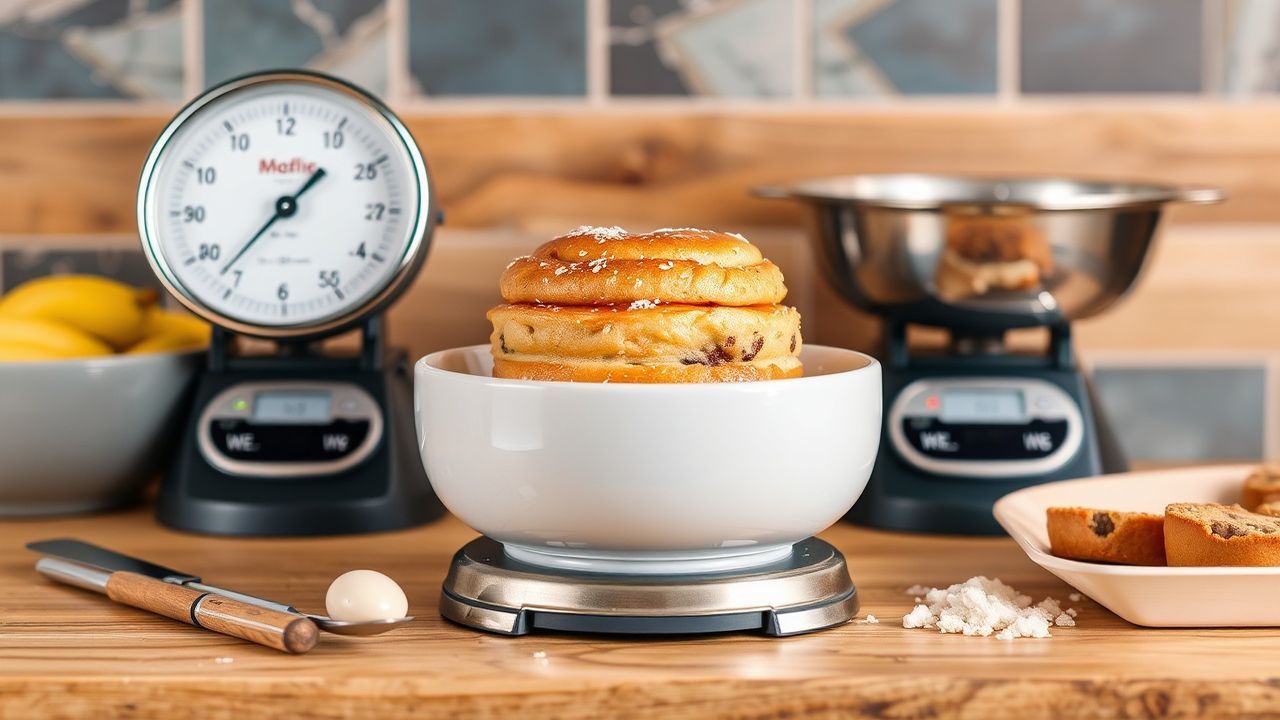

Precision transforms baking from guesswork into repeatable success. This guide, Weigh to Bake: Top kitchen scales for perfect baking, explains how the right tools affect texture, rise, and flavor.
- Use weight, not volume to remove variation across batches.
- Choose resolution with purpose: 0.1 g for pastry, 1 g for general baking.
- Prioritize tare and stability to speed mise en place and avoid error.
Prep and Cook Time
Prep Time: 5 minutes. Set up and calibrate the scale on a flat surface before you begin.
Cook Time: N/A. This guide evaluates equipment and buying criteria rather than a recipe bake time.
Yield
This guide yields a clear checklist to buy and use a baking scale that improves repeatability. It helps home bakers and professionals reduce variability across recipes.
Apply the checklist to any recipe, from lean breads to tender pastries, to produce consistent texture and flavor. Weight-based recipes scale predictably between batch sizes.
Difficulty Level
Easy. Choosing and using a kitchen scale requires little technical skill but benefits from attention to features and placement.
If you already weigh ingredients, expect refined guidance on resolution, calibration, and smart features. If you are new, this makes the buying decision straightforward.
Ingredients for Effective Baking Weighing
Accurate measurement requires the right equipment and habits. A scale with clear resolution, reliable tare, and a stable platform forms the core of repeatable weighing routines.
Essential features include unit conversion, non-slip feet, a backlit display, and splash-resistant materials. These traits reduce user error and sensor drift.
- Resolution: 0.1 g for pastry work; 1 g for general baking.
- Units: grams, ounces, milliliters when applicable.
- Tare function: Zeroes container weight to add multiple ingredients in one vessel.
- Platform: Size and shape must fit your mixing bowls.
- Durability: Stainless surfaces and splash resistance extend life.
Instructions for Choosing and Using Your Ideal Kitchen Scale
Start by matching scale capability to your baking style. Professional pastry work needs finer resolution and better calibration than casual batch baking.
Then evaluate ergonomics: display readability, button layout, and platform size influence daily use. Test these where possible before purchase.
Precision and Resolution
Resolution defines the smallest increment a scale reports. Choose 0.1 g for delicate doughs and temper-sensitive recipes; 1 g applies to everyday bread and cookies.
Accuracy and resolution are different metrics. Check manufacturer specs on linearity and repeatability when accuracy matters most.
Tare, Capacity, and Stability
Tare simplifies mise en place by letting you measure successive ingredients in one bowl. Verify the tare returns to zero with typical container weights.
Capacity matters: larger-capacity scales handle big batches but sometimes sacrifice fine resolution. Aim for a balance: 5 kg capacity with 0.1 g or 1 g increments depending on needs.
Smart Features and Integration
Some scales offer Bluetooth and companion apps for recipe logging and batch records. These features can speed workflows and support nutrition tracking when used properly.
Prioritize measurement quality over bells and whistles. A connected scale only helps if base readings are stable and repeatable.
Chef’s Notes: Tips for Success with Kitchen Scales
Place the scale on a flat, vibration-free surface for stable readings. Counter edges and uneven shelving introduce error.
Use tare often. It saves cleaning and keeps workflow simple by allowing multiple adds to a single container without manual subtraction.
Clean spills promptly. Moisture and sugar can creep into seams and affect sensors over time. Wipe with a damp cloth and avoid submerging electronic scales.
Store the scale flat and protect the platform from heavy objects. Repeated drops or pressure will shift calibration and shorten device life.
Serving Suggestions: Presenting Your Baking Mastery
When you bake with weight-based precision, presentation improves because texture and structure become predictable. Portion slices using the same scale to maintain uniformity.
For bakeries or events, a scale helps portion consistent servings. That consistency supports customer satisfaction and accurate labeling.
Feature Comparison
The table below summarizes key features and the typical advantage each provides in a baking context. Use it to prioritize purchases by workflow and recipe type.
Look for repeatability (same input returns same value), linearity (accuracy across range), and drift resistance (stable over time). Those metrics predict long-term reliability.
| Feature | Benefit | Best For |
|---|---|---|
| Precision (0.1 g) | Fine dosing for delicate pastry and confectionery | Pastry chefs, precision bakers |
| Tare Function | Measure multiple ingredients in one container | All bakers, small kitchens |
| Smart Connectivity | Sync recipes, log batches, track nutrition | Tech-savvy bakers, diet-focused users |
| Platform Size | Accommodates large bowls or compact storage | Home kitchens with varied tools |
Calibration and Maintenance
Most consumer scales hold calibration for regular home use, but heavy use or rough handling requires periodic checks. Use known weights or water measures to verify output.
For a quick check, one liter of water equals 1000 g under standard conditions. Use that relationship to run a basic accuracy test without specialized weights.
Replace batteries proactively or choose rechargeable power. Low battery states can cause erratic readings or auto-shutoff that interferes with workflows.
If your scale shows drift despite fresh power and stable placement, seek professional recalibration or switch to a certified model for critical applications.
Standards and Measurement Basics
Understanding basic units helps when recipes switch between metric and imperial systems. The gram and kilogram remain the most consistent units for baking proportions.
For background on the gram and measuring tools, consult reference material such as the unit gram and general weight concepts. See the gram entry for context: gram. Learn how weighing devices work at weighing scale.
Kitchen measurement history clarifies why weight-based baking became standard. Read about kitchenware and baking practice to broaden your knowledge: kitchenware and baking.
Why Weight Matters in Baking
Weight removes variables from recipes. Flour density, scoop technique, and humidity all change volume measurements; weight provides an objective metric.
Relying on grams standardizes hydration percentages in breads and baker’s formulas, so you reproduce crumb and oven spring consistently. Weight-based workflows simplify scaling between batch sizes.
FAQ
What resolution do I need for pastry versus bread?
Use 0.1 g resolution for pastry work like macarons or temper-sensitive confectionery. For bread and general baking, 1 g resolution balances cost and performance.
If you switch between applications frequently, consider a dual-range scale or two dedicated scales for different tasks.
Can I measure liquids on a kitchen scale?
Yes. Many scales convert volume to weight or display milliliters based on density assumptions. For water-based liquids, 1 ml approximates 1 g under standard conditions.
For viscous liquids such as honey or oil, weigh directly by grams to avoid cup-to-cup variability. Weighing improves recipe accuracy and consistency.
How often should I calibrate my scale?
Calibration needs depend on use intensity. Home bakers can check quarterly; professionals should check monthly or whenever readings change after movement.
Use certified weights for calibration if available. Otherwise, a water-based check at known volumes provides a quick sanity test.
Are expensive scales worth the price?
Higher-cost models often use better sensors, faster response, and stronger construction. For high-volume or professional environments, the investment pays through reliability.
For casual bakers, mid-range models with proven repeatability will meet most needs without premium features like app integration.
Where can I learn more about kitchen tools and measurement?
Industry and historical context can help you understand why weight-based baking became standard. Read background on kitchenware and weighing practices to broaden practical knowledge.
Applying measurement fundamentals leads to consistent results and less frustration when scaling and replicating recipes.
Closing Remarks
Choose the right scale by matching resolution, capacity, and durability to your baking style. Focus on consistent, tested measurements rather than marketing claims.
When you adopt weight-based workflows, you gain predictability and efficiency. Use the checklists and maintenance steps here to keep your scale accurate and your bakes consistent.
Happy weighing, and happy baking.
See also: kitchen scales and baking tools
Recommended Reading:
- Maple Butter: 5 Recipes for Breakfast & Dinner
- Fluffy Biscuits: 5 Secrets for Bakery-Soft, Buttery Perfection
- 7 Irresistible Recipes Using Smoked Salt Spread That Transform Everyday Meals