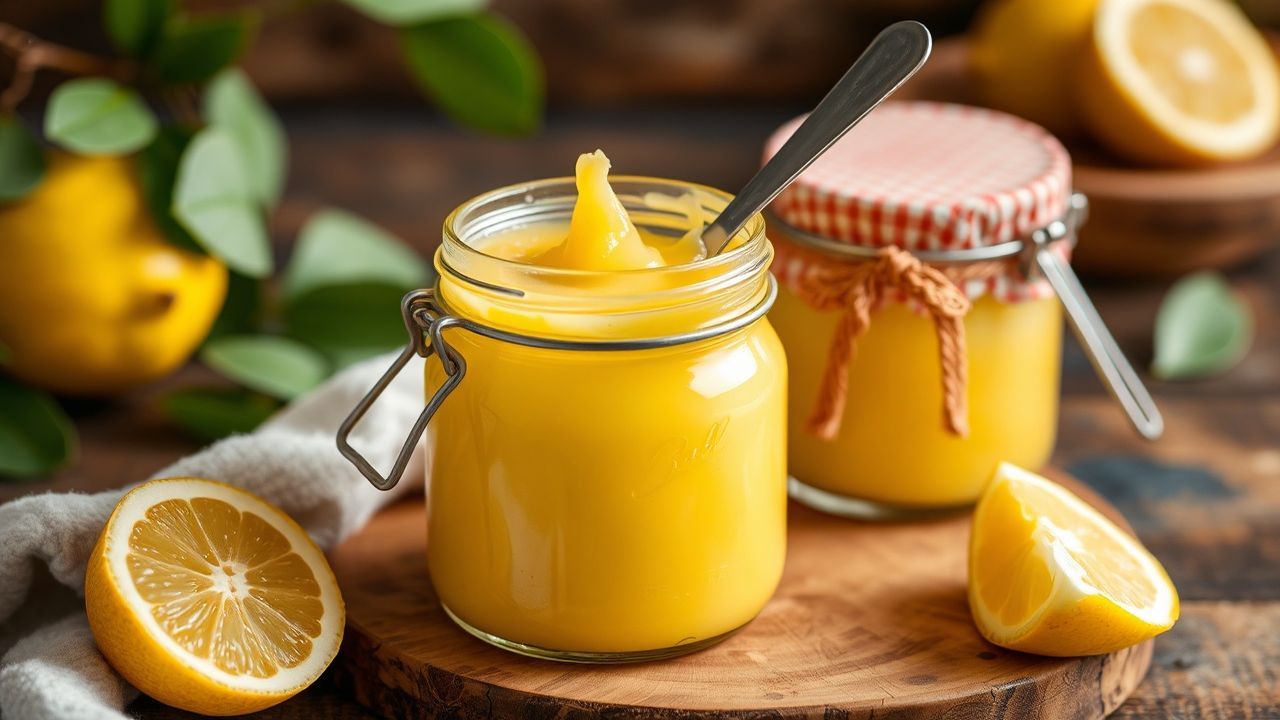

There’s something irresistibly bright and tangy about homemade lemon curd — a silky spread that brings concentrated citrus flavor to scones, cakes, and spoons alike. With a few careful techniques, you can produce a glossy, balanced curd that stores well and improves with time.
- Yield: about 1½ cups (6 servings).
- Time: 27 minutes total using a double-boiler approach.
- Texture: smooth custard-like curd that coats a spoon.
- Storage: refrigerated for up to 1–2 weeks; freeze for months.
Prep and Cook Time
Preparation: 15 minutes. Cooking: 12 minutes. Total: 27 minutes.
First, prepare equipment and ingredients to move smoothly. Assemble a heatproof bowl, a saucepan for a water bath, a silicone spatula, and a fine-mesh sieve to finish the curd with a silky texture.
Yield, Difficulty and Key Notes
This recipe yields roughly 1½ cups, enough for jars or several dessert uses. The technique rates as medium: it’s beginner-friendly but requires attention to low heat and continuous stirring to avoid curdling.
Using fresh, unwaxed lemons gives the best aroma and flavor because the zest contains essential oils. For background on citrus varieties, see lemon.
Ingredients
Measure ingredients precisely to achieve the proper custard set and balance of sugar, fat, and acid. Room-temperature eggs incorporate more smoothly and yield a more consistent texture.
Ingredients list:
- 4 large fresh lemons — zest and juice (expect about 1/2 cup juice).
- 1 cup granulated sugar
- 4 large eggs, at room temperature
- 6 tablespoons unsalted butter, cold and cubed
- Pinch fine sea salt
For more on the role eggs play in thickening custards, consult the overview of egg (food).
Instructions
Follow steps precisely and keep the heat gentle. The double-boiler method reduces the risk of scrambled eggs by applying indirect, even heat.
- Zest and juice: Zest all lemons first, avoiding the bitter pith. Then juice to collect about 1/2 cup fresh lemon juice.
- Whisk eggs and sugar: In a medium heatproof bowl, whisk eggs, sugar, and salt until smooth and the sugar starts to dissolve.
- Set up a double boiler: Bring a few inches of water to a gentle simmer in a saucepan. Place the bowl over it so the bottom does not touch the water.
- Cook while stirring: Stir constantly with a silicone spatula. Gradually add zest and lemon juice. Cook until the curd thickens and reaches about 170°F (77°C) or coats the back of a spoon, usually 10–12 minutes.
- Finish with butter: Remove from heat and whisk in cold butter cubes one at a time. This ensures a glossy finish and stable emulsion.
- Strain and cool: For an ultra-smooth curd, press through a fine-mesh sieve to remove any bits of cooked egg or zest. Cover the surface with plastic wrap and chill.
For the technique of indirect heating using a double boiler, review the method at double boiler.
Tips for Success
Small adjustments change texture and flavor dramatically. Keep the heat low and stir frequently; patience prevents lumps and separation.
Scan-friendly tips:
- Use unwaxed lemons for brighter oils in the zest.
- Warm eggs to room temperature for even cooking.
- Cube cold butter so it emulsifies gradually and yields a glossy curd.
- Strain the curd to remove any coagulated bits and ensure a silken finish.
Also consider adjusting sugar to taste; less sugar increases tang and shortens perceived sweetness. For flavor variations, add a splash of vanilla or a teaspoon of grated ginger, added at the end to preserve volatile aromatics.
Storage and Shelf Life
Proper cooling and airtight storage extend shelf life and preserve texture. Press plastic wrap directly onto the curd surface before sealing to prevent skin formation.
Refrigerated curd keeps well for about 1–2 weeks when stored in a clean jar; freeze for up to three months in an airtight container. Thaw slowly in the refrigerator and whisk gently before serving to restore creaminess.
Serving Suggestions
Serve lemon curd warm or chilled. It pairs beautifully with scones, pancakes, tart shells, and layered parfaits for a bright contrast to richer elements.
Try spooning curd over Greek yogurt and granola, filling tart shells, or using it between cake layers. For a simple treat, spread it on toasted brioche or serve as a dip for fresh berries.
Nutritional Information (Per Serving)
Approximate nutrition varies by exact ingredients and portion size. Here is a sample breakdown per serving (about 2 tablespoons):
| Calories | Protein | Carbs | Fat |
|---|---|---|---|
| 120 kcal | 2 g | 22 g | 3.5 g |
To lower calories, reduce butter slightly or use a light spread, though flavor and mouthfeel will change. Nutritional tools and labels can help you calculate precise macros for your ingredients.
Troubleshooting Common Issues
Curd that’s grainy or scrambled indicates overcooking at too-high heat. When you see small curdled bits, quickly remove from heat and strain; chilling can also help them blend back slightly after whisking with butter.
If your curd separates or looks oily, the emulsion broke. Whisk vigorously off heat and add a teaspoon or two of cold water or a small cube of cold butter to coax the emulsion back together.
FAQ
What exactly is lemon curd?
Lemon curd is a thickened spread made from lemon juice, sugar, eggs, and butter. It cooks to a custard-like consistency and sets when chilled.
Why make lemon curd at home?
Homemade curd offers brighter citrus flavor and control over sugar and butter. It also lacks preservatives and allows customization of texture and aroma.
How do I know when my lemon curd is done?
The curd is done when it coats the back of a spoon and holds a light trail when you run your finger through it. Target a temperature near 170°F (77°C) for a safe, set custard.
Can I add other flavors?
Yes. Small additions like vanilla, ginger, or citrus liqueur at the end enhance complexity. Add delicate aromatics after removing from heat to preserve their nuance.
How long does homemade lemon curd keep?
Store in a clean, airtight jar in the refrigerator for 1–2 weeks. For longer storage, freeze in portions for up to three months and thaw in the fridge before use.
For more reference on butter and its culinary behavior, see butter. For background on lemon curd itself, consult lemon curd.
Making lemon curd rewards careful technique with intense, fresh citrus flavor. With practice, you’ll find the rhythm of zesting, whisking, and gentle cooking that produces consistently glossy, spreadable curds.
See also: lemon curd