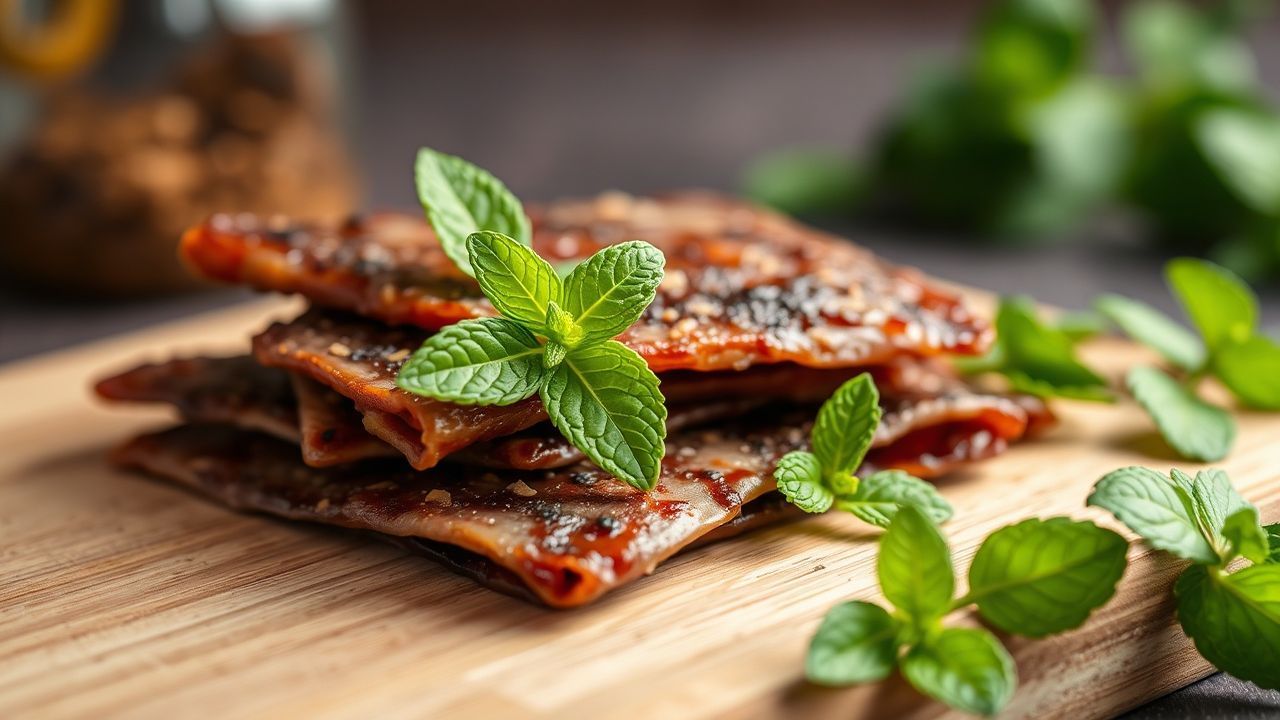

Classic lamb jerky gets a bright makeover when you add fresh mint. This recipe pairs slow-cured lamb with cucumber-cool herb notes to create a jerky that tastes clean, savory, and surprisingly complex.
- Bright mint balances rich lamb: Mint lifts the natural gaminess without masking it.
- Safe drying matters: Follow temperature and time guidance to eliminate risk.
- Storage extends shelf life: Vacuum sealing and refrigeration keep flavor steady.
Prep and Cook Time
Preparation: 30 minutes of active work gets your strips trimmed and marinated. Use uniform slices to ensure even drying and predictable finish.
Marinating and drying: Marinate at least 12 hours; 24 hours yields deeper mint penetration. Dry 6–8 hours depending on your dehydrator or oven temperature and meat thickness.
Yield
This batch yields roughly 12 servings of mint-tinted jerky when made with 2 pounds of lamb. Portion size will vary with slice thickness and moisture lost during drying.
Expect about 10–14 ounces of final jerky per pound of raw meat after trimming and dehydration. Label batches with date for rotation.
Difficulty Level
Medium. The technique requires attention to slicing, marinade balance, and drying temperature control. Beginners will succeed by following the timing and safety cues below.
Tools: a sharp knife, a dehydrator or low-temperature oven, and airtight containers or vacuum bags. These make the process repeatable and safe.
Ingredients
Use lean lamb leg trimmed of excess fat for the best dry texture. Excess fat remains soft and can shorten shelf life, so remove it before slicing.
Core flavor ingredients: fresh mint, soy or tamari, lemon juice, garlic, honey, cumin, smoked paprika, optional red pepper flakes, olive oil, and black pepper. Fresh mint is critical to preserve the cooling top notes.
- 2 lbs thinly sliced lamb leg, trimmed
- 1 cup fresh mint leaves, finely chopped
- ½ cup low-sodium soy sauce or tamari
- 2 tbsp fresh lemon juice
- 3 cloves garlic, minced
- 1 tbsp honey
- 1 tsp ground cumin
- 1 tsp smoked paprika
- ½ tsp crushed red pepper flakes (optional)
- ¼ cup extra virgin olive oil
- Freshly ground black pepper to taste
Instructions
Structure the process into four focused phases: prepare, marinate, dry, and finish. Each phase demands consistent technique for safe, flavorful jerky.
Keep a kitchen thermometer handy. Valid internal-temperature checks and stable drying environments prevent microbial risk and deliver consistent texture.
Prepare the lamb
Pat lamb slices dry with paper towels to remove surface moisture before marinating. Dry meat adheres to marinade better and dries more evenly.
Trim all visible fat. Slice against the grain into roughly 1/4-inch strips for balanced chew and predictable drying time. Uniformity reduces over- or under-dried pieces.
Make the mint marinade
Whisk chopped fresh mint with soy, lemon juice, garlic, honey, cumin, smoked paprika, olive oil, and black pepper. Emulsify well so oils and liquids coat fibers evenly.
Adjust salt and acidity to taste; bright lemon counters richness, while a touch of honey rounds the herbaceous edge. Avoid dried mint; it lacks the volatile oils that make the flavor pop.
Marinate the lamb
Place lamb strips and marinade in a non-reactive container or resealable bag and refrigerate. Turn the pieces once or twice to ensure uniform infusion.
Allow at least 12 hours; 24 hours gives stronger mint presence. If you extend beyond 24 hours, check texture—acidic marinades can begin to break down muscle fibers.
Drying and finishing
Set a dehydrator to 155°F (68°C) or use the lowest oven setting near 170°F (77°C). Arrange strips without overlap for free airflow.
Dry 6–8 hours, flipping halfway. The finished jerky should be flexible but dry to the touch with no visible moisture. Cool fully before packaging to avoid condensation.
Tips for Success
Slice uniformly and choose consistent piece sizes for even drying. Small deviations in thickness make large differences in final texture.
Monitor both ambient and internal temperatures during drying. A combination of thermometer checks and tactile testing yields the best results.
Consider a brief preheat step in the dehydrator or oven to bring meat surface temperature up quickly. This jump-starts safe drying and shortens zone where bacteria could survive in moist conditions.
Rest jerky out of the drying unit until completely cool, then seal. Hot or warm meat trapped in airtight bags causes condensation and spoilage.
Label packages with date and batch notes, especially if you vary mint quantity or drying time. This habit speeds troubleshooting and improves reproducibility.
Serving Suggestions
Mint-infused lamb jerky works well on a Mediterranean-style board alongside hummus, olives, and tangy cheeses. The herb’s cooling quality balances fatty and salty elements.
For bright pairings, serve with a simple cucumber-yogurt dip or a squeezed lemon drizzle. Salted nuts and dried stone fruit also complement the savory-sweet profile.
For context on Mediterranean small-plate culture and ingredient pairings, consult meze and classic mezze combinations. These references clarify how herbs and cured proteins interact on shared plates.
Nutrition and Storage
Expect approximately 120 calories and about 18 grams of protein per serving in a typical 1-ounce portion. Protein density makes jerky an efficient, portable snack for active use.
Store cooled jerky in airtight containers. Refrigerate for up to two weeks or freeze for longer-term storage to preserve aroma and texture.
| Nutrient | Per Serving |
|---|---|
| Calories | 120 |
| Protein | 18g |
| Carbohydrates | 3g |
| Fat | 4g |
For general principles on nutrient balance and food composition, see nutrition. Understanding macronutrient ratios helps you scale marinades and portions to meet dietary goals.
Food-Safety References
Follow validated temperature guidelines and handle raw meat with standard sanitation practices to minimize risk. Consistent surface drying and adequate heat exposure lower microbial hazards.
For background on drying as a preservation method, consult the technical overview at food drying. This source outlines moisture-activity principles and historical methods used worldwide.
Flavor Science: Why Mint Works
Mint contains menthol and aromatic terpenes that deliver cooling and lift. These volatile compounds contrast with lamb’s heavier fatty flavor, creating a layered tasting experience.
Combining mint with acid (lemon) and a touch of sweet (honey) rounds the flavor profile and prevents perception of metallic or overly gamey notes. Balance matters more than quantity.
For a botanical overview of mint species commonly used in cooking, see Mentha. Different mint varieties emphasize different aromatic characters.
FAQ
This FAQ section answers common practical questions about making and storing mint-infused lamb jerky. Short, direct responses help you apply techniques quickly.
If you need deeper troubleshooting, keep notes about slice thickness, marinating time, and drying temperature; those variables determine most outcomes.
Is lamb jerky safe to make at home?
Yes, when you follow safe practices: trim fat, maintain clean surfaces, and ensure drying involves sustained temperatures that reduce pathogens. Use a thermometer to confirm internal and ambient temperatures.
Can I use dried mint instead of fresh?
Fresh mint provides volatile oils that give the signature cooling lift. Dried mint will add some flavor but lacks the brightness and may change the jerky’s aromatic profile.
How long does mint-infused lamb jerky keep?
Store in an airtight container at room temperature for short periods, refrigerated for up to two weeks, or frozen for several months. Vacuum sealing extends shelf life and preserves freshness.
Can I substitute beef or venison?
Yes. The mint technique translates to other red meats, but adjust marinating and drying times to account for differing fat content and fiber structure. Leaner meats dry faster and require careful timing.
What causes jerky to be too tough?
Over-drying, slicing with the grain, or choosing overly lean cuts can produce tough jerky. Slice against the grain and monitor drying time to leave a flexible chew.
For a focused, reproducible outcome, document each batch’s variables. Consistent records let you refine mint quantity, marinating windows, and drying endpoints to build a signature jerky you can trust.
See also: lamb jerky