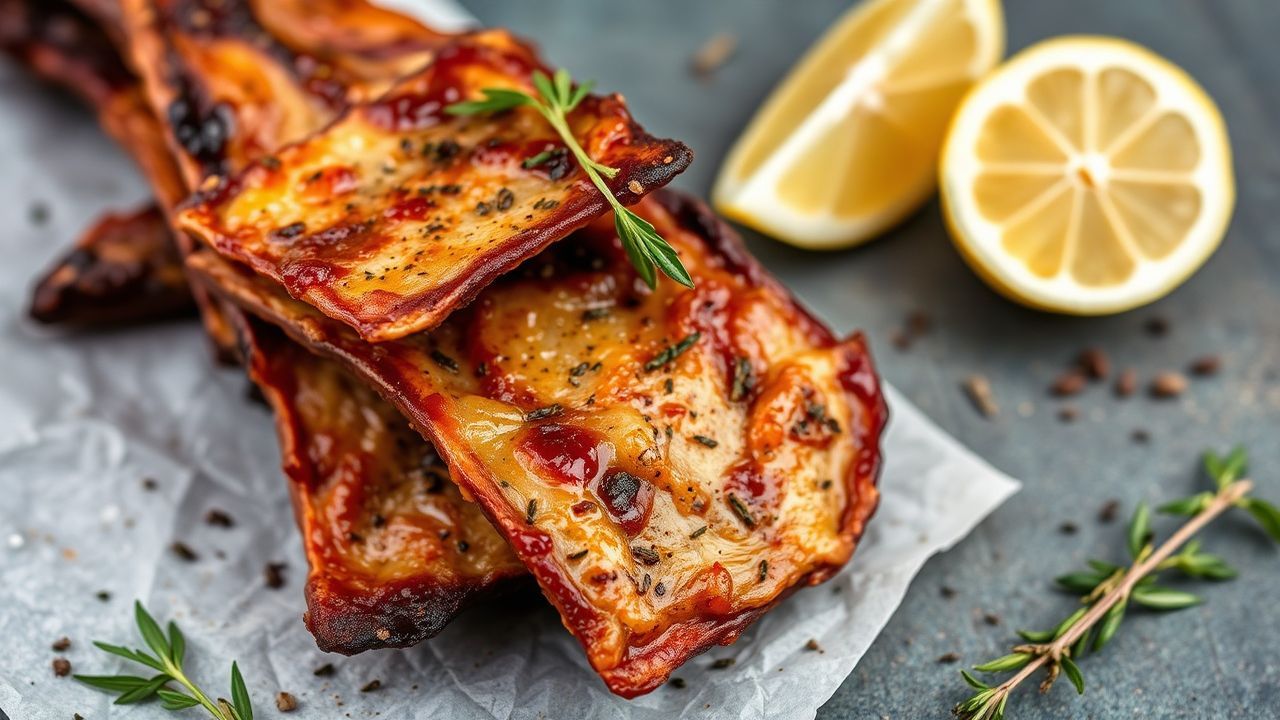

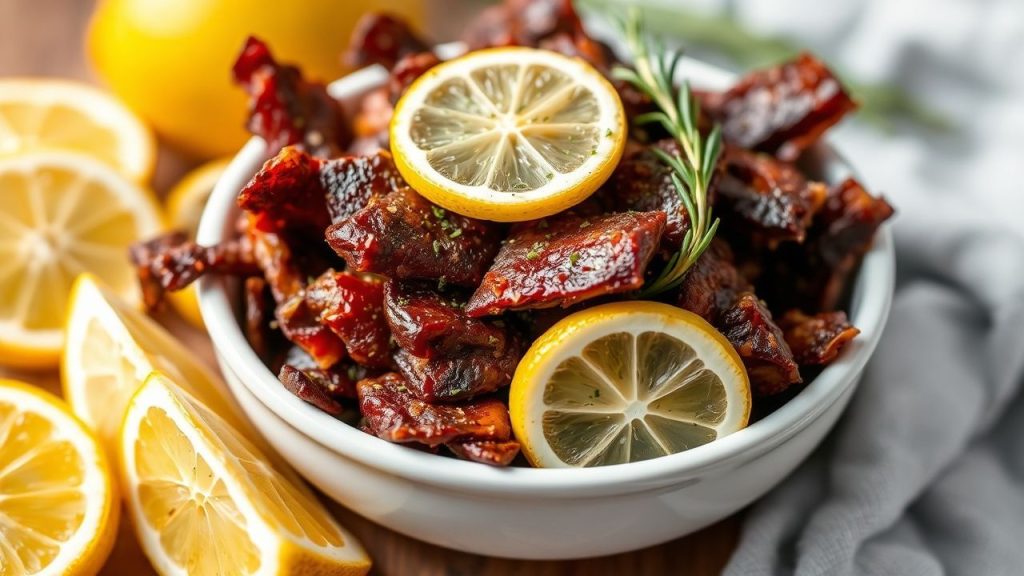
The first bite of well-made turkey jerky should deliver bright lemon, layered herbs and a focused, clean chew. This guide teaches precise steps for lemon-herb turkey jerky that stays tender, safe and flavorful.
- Balance acid and oil: lemon for brightness, oil for even flavor absorption.
- Temper dehydration: low, steady heat yields pliable jerky rather than brittle strips.
- Lean cuts matter: turkey breast gives consistent drying and shelf stability.
- Storage wins: cool, dry, airtight packaging preserves texture and safety.
Prep and Cook Time
Preparation: 20 minutes. Keep knife work efficient and use a timer for consistent slices.
Marinating: 6–8 hours. Marination lets acid and aromatics tenderize and flavor the meat.
Dehydration: 6–8 hours at controlled temperatures. Check early to avoid over-drying.
Yield
This batch yields about 8 ounces of finished jerky, roughly 8 snack servings. Yield varies with slice thickness and moisture loss.
Expect roughly 60–65% weight loss from raw to dried when using 1/4-inch slices of turkey breast.
Difficulty Level
Medium. The method uses simple tools but requires attention to slicing, marinade balance and dehydration time.
Most home kitchens will manage this with a sharp knife and a dehydrator or low-temperature oven.
Ingredients
Keep ingredients measured and at hand. Precise ratios help reproducible flavor and safe curing.
- 2 pounds turkey breast, skinless, sliced 1/4″ against the grain
- 1/4 cup fresh lemon juice (about 2 lemons)
- 2 tbsp extra-virgin olive oil
- 3 cloves garlic, minced
- 1 tbsp fresh rosemary, chopped
- 1 tbsp fresh thyme leaves
- 1 tsp sea salt
- 1/2 tsp freshly ground black pepper
- 1 tsp crushed red pepper flakes (optional)
- 1 tbsp honey or maple syrup
- 1 tsp smoked paprika
The Art of Crafting the Perfect Lemon Herb Marinade
Marinade is the flavor engine. Use fresh lemon juice for acidity and olive oil to carry fat-soluble aromatics into the meat.
Whisk garlic, herbs, salt, pepper and honey into the lemon and oil until emulsified. Even coating produces even flavor and consistent dehydration.
Why fresh ingredients matter
Fresh lemon gives volatile citrus oils that brighten the profile without adding bitterness. For context on lemon chemistry, consult lemon.
Fresh rosemary and thyme release essential oils that survive dehydration and continue to flavor each bite.
Selecting Quality Turkey Cuts for Tender Jerky
Choose lean, firm turkey breast with minimal visible fat or connective tissue. Fat can go rancid and will slow drying.
Partially freeze the breast for 30–45 minutes to make clean, even 1/4-inch slices. Slice against the grain for a more tender bite.
Meat safety and sourcing
Buy poultry from a reputable supplier and keep it cold from purchase through processing. For biological context on the species, see turkey.
Trim connective tissue and silver skin to prevent chewy bits and ensure uniform drying.
Step-by-Step Dehydration Techniques for Optimal Flavor
Successful dehydration uses consistent temperature, airflow and monitoring. Set the dehydrator to 160°F (71°C) for lean poultry to meet safety and texture goals.
Arrange strips in a single layer to allow uninterrupted airflow. Rotate trays if your unit has hot spots.
Seven practical steps
1. Combine ingredients and whisk until emulsified. Ensure honey dissolves evenly for balanced caramelization during drying.
2. Submerge turkey in marinade; refrigerate 6–8 hours. Turn the bag or stir every 2 hours for uniform penetration.
3. Preheat dehydrator to 160°F (71°C). If using an oven, use the lowest setting and prop the door open slightly to maintain airflow.
4. Remove excess marinade; do not rinse. Lay slices flat without overlap for even drying.
5. Dehydrate 6–8 hours. Check at 5 hours; properly dried jerky bends and shows internal fiber separation without snapping.
6. Cool to room temperature on racks, then pack airtight. For longer-term storage, vacuum seal and freeze.
Creative Serving Suggestions to Elevate Your Homemade Jerky
The lemon-herb profile pairs well with creamy, savory accents. Dice jerky over salads or fold into warm grain bowls for texture and protein.
For appetizer service, thinly slice and present with citrus-herb yogurt or roasted nuts. Add fresh zest and herb sprigs to highlight aroma.
Pairings and presentation
Serve with a crisp white wine or a hop-forward beer to contrast citrus and herb notes. Use small skewers for cocktail-friendly bites.
Include jerky on a protein-forward board with olives, aged cheese and toasted seeds for a balanced tasting experience.
Tips for Success
Consistency matters: uniform slices, consistent marinade coverage and steady dehydration temperatures produce repeatable results.
Keep a kitchen log for batch times, temperatures and marinade tweaks. This practice turns trial-and-error into reliable technique.
Flavor variations
For umami depth, add a teaspoon of soy sauce or a splash of apple cider vinegar to the marinade. Adjust salt to taste when adding salty ingredients.
Smoked paprika amplifies perception of smoke without a smoker. Add crushed red pepper for controlled heat.
Store fully cooled jerky in airtight containers. For practical storage guidance, see our internal resource on jerky storage.
If you want to compare techniques for different meats, consult our Ultimate Beef Jerky Guide for temperature and timing parallels.
Nutrition Snapshot
Per serving (approx. 1 ounce): roughly 90 calories, 18 g protein, 2 g carbs and 1 g fat. Turkey is lean and offers high protein density.
Adjust marinades to manage sodium and sugar if you follow dietary restrictions. Use the nutritional facts to scale portions for meal planning.
| Nutrient | Per Serving |
|---|---|
| Calories | 90 |
| Protein | 18 g |
| Carbohydrates | 2 g |
| Fat | 1 g |
Q&A
Below are targeted answers to common technical and culinary questions about lemon-herb turkey jerky.
Q1: What makes turkey jerky a better choice than beef for some eaters?
Turkey offers a leaner protein profile and milder flavor that readily accepts citrus and herb notes. It dehydrates faster than fattier red cuts, reducing total drying time.
Those tracking calories or saturated fat often prefer turkey while retaining a satisfying chew.
Q2: How long should I marinate for maximum tenderizing without over-acidifying?
Six to eight hours strikes a practical balance. Acids like lemon tenderize but can firm the meat if left too long.
Monitor texture with a test strip at 6 hours, then adjust future batches based on that result.
Q3: Can I use the oven instead of a dehydrator?
Yes. Use the oven’s lowest setting and allow airflow by propping the door slightly open. Rotate racks for even drying.
Maintain target temperatures similar to dehydrator recommendations and monitor early to prevent over-drying.
Q4: How do I tell when jerky is done?
Proper jerky bends and cracks along the grain but does not snap. The surface should feel dry and slightly tacky where sugars concentrated.
If you observe white powder or off-odors during storage, discard the batch; that indicates spoilage or improper drying.
FAQ
How long does homemade lemon herb turkey jerky last?
Properly dried and sealed jerky stores at room temperature for up to two weeks. Refrigerate for up to a month, or vacuum-seal and freeze for several months.
Can I use dried herbs instead of fresh?
Yes. Use roughly one-third the quantity of dried herbs by volume compared with fresh because dried herbs concentrate flavor.
What temperature is safe for dehydrating poultry?
Set dehydrators to 160°F (71°C) for poultry to reduce microbial risk while producing a stable texture.
Why does my jerky get brittle?
Brittle jerky indicates over-drying or too-high temperature. Reduce drying time or lower temperature and test strips earlier in the process.
Where can I learn more about drying principles?
See the general overview of dehydration science at food dehydration for fundamentals on moisture removal and safety.
Closing Notes
Focused technique, controlled temperatures and fresh ingredients produce lemon-herb turkey jerky that is tender and flavorful. Track your variables and adjust for your taste.
For more method variations, explore herb profiles like rosemary and thyme; background on rosemary chemistry is available at rosemary. For preservation context, review food preservation.
See also: turkey jerky