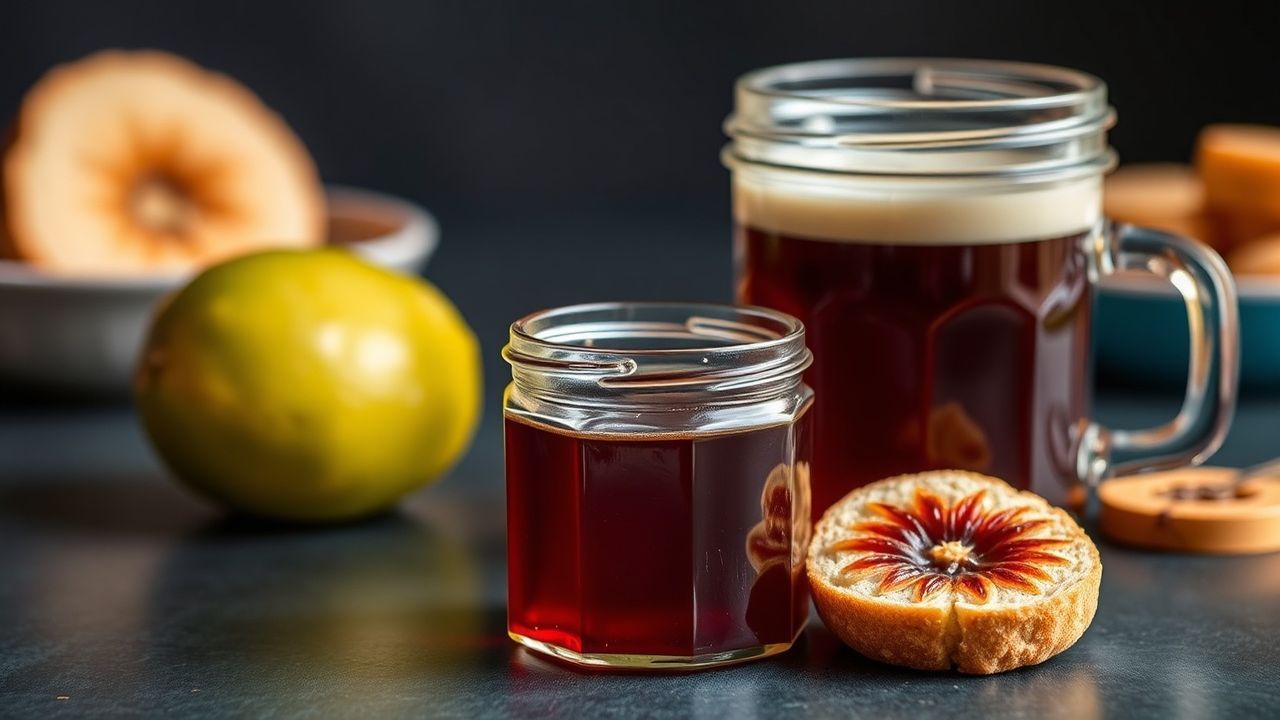

Brew & Jelly turns a favorite craft beer into a glossy, spreadable jelly that pairs with cheese, pork, and toast. This guide gives clear ratios, technical tips, and preservation best practices so your jars set reliably and taste intentional.
- Choosing your brew
- Prep and cook time
- Yield and difficulty
- Essential ingredients and tools
- Step-by-step guide to brewing and jelly-making techniques
- Creative serving suggestions and pairings
- Chef’s notes, troubleshooting, and technical tips
- Ingredient science and substitutions
- Nutrition and portioning
- Common problems and fixes
- References and further reading
- FAQ
- Key balance: beer flavor + sugar + acid + pectin = reliable set.
- Safety first: proper jar processing prevents spoilage and keeps flavor intact.
- Flavor play: choose beer styles to match your pairing plan.
- Test and adjust: a gel plate test and minor pectin tweaks solve most setting problems.
Choosing your brew
Pick a beer that defines the jelly’s character rather than overwhelms it. Use amber ales or malty saisons for rounded sweetness, or pick citrusy IPAs if you want bright, hop-driven notes.
For technical background on beer ingredients and how malt and hops affect taste, consult the authoritative beer entry on beer. That helps you predict how flavors concentrate when you reduce the liquid.
Prep and cook time
Preparation: 15 minutes of jar sterilizing and mise en place. Keep a clean workstation and measured ingredients to minimize errors during the hot-cook stage.
Cooking: 20–25 minutes total, including a 4–6 minute reduction and a 1–2 minute full rolling boil to activate pectin. Timing matters because pectin activation requires sustained high heat.
Yield and difficulty
This recipe yields about two half-pint jars (roughly 1 cup total). That small batch size helps you troubleshoot flavor and set with minimal waste.
Skill level: intermediate. You should be comfortable with boiling liquids, reading a candy thermometer, and processing jars in a hot-water canner for safety and shelf stability.
Essential ingredients and tools
Ingredients (base): 1 cup craft beer, 2 cups granulated sugar, 3 tablespoons powdered fruit pectin, 1 tablespoon lemon juice, 1/4 cup apple cider vinegar. These ratios aim for a standard high-sugar jelly Brix suitable for regular pectin.
Tools: heavy-bottomed saucepan, wooden spoon, funnel and ladle, sterilized half-pint jars with lids, candy thermometer (optional), and a chilled plate for gel testing. Sanitation and correct headspace are non-negotiable.
Step-by-step guide to brewing and jelly-making techniques
Work clean and organized: sterilize jars, measure sugar and pectin before heating, and keep acid (lemon juice, vinegar) at hand. Start hot, work quickly, and end with an immediate jar fill to preserve clarity and aroma.
The process breaks into three technical stages: reduction, pectin activation, and jar processing. Each stage influences texture, flavor concentration, and final shelf stability.
Reduction and flavor concentration
Pour 1 cup of beer into a heavy-bottomed saucepan and bring to a gentle simmer. Reduce for 4–6 minutes to concentrate aromas and evaporate excess carbonation that can interfere with pectin action.
Reduction intensifies malt and hop compounds, so taste a small cooled sample to decide if you want additional acidity or sweetness. Balance now; adjustments after pectin activation are limited.
Pectin activation and boil
Whisk in sugar until dissolved, then add pectin gradually to avoid clumping. Bring the mixture to a full rolling boil and maintain that boil for 1 minute to allow pectin chains to cross-link and form a stable gel.
Use a cold plate gel test: place a teaspoon of hot jelly on a chilled plate and cool one minute; if it wrinkles when pushed, the gel point is reached. If not, boil another 30–60 seconds and retest rather than adding more sugar.
Jar filling and processing
Remove from heat, stir in lemon juice and apple cider vinegar to set acidity and improve gel reliability. Fill sterilized jars with a funnel, leaving 1/4-inch headspace, wipe rims, and seal with lids tightened finger-tight.
Process jars in a boiling water bath for 10 minutes to ensure a safe vacuum seal and shelf stability. Processing time varies by altitude; adjust according to local canning charts and altitude corrections.
If a jar fails to seal after cooling, refrigerate and use first or reprocess with a new lid. Proper seals protect both safety and flavor longevity.
After processing, allow jars to cool on a towel undisturbed for 12–24 hours. Check lids for concavity and absence of flex; a firm, concave lid indicates a proper vacuum seal.
Creative serving suggestions and pairings
Beer jelly adds a complex sweet-bitter note to savory boards and breakfast items. Pair bold jellies with aged cheddar, mild jellies with goat cheese, and darker stout jellies with roasted meats for contrast.
Other uses include glazing sausages, mixing into vinaigrettes for salad brightness, or spooning over ricotta with citrus zest. Small additions amplify dishes without dominating them.
- Cheese pairing: sharp cheddar or blue cheese.
- Appetizer: warm goat-cheese crostini brushed with jelly.
- Glaze: use as a reduction glaze for pork or sausages.
- Dressing: blend with olive oil and vinegar for vinaigrettes.
Chef’s notes, troubleshooting, and technical tips
Adjust pectin dosage based on sugar content: commercial powdered pectin assumes high sugar. If you plan a lower-sugar batch, use low-sugar pectin and follow its packet instructions for optimal gel points.
Acidity influences gel strength. Add lemon juice and vinegar before the final boil so they integrate and support pectin’s ability to form a stable network. Too little acid can prevent setting.
If your jelly turns out too runny, gently rehearse it with a pectin slurry according to the pectin manufacturer’s instructions. Avoid overcooking sugar, which can darken flavor and reduce set quality.
Store unopened jars in a cool, dark pantry for up to 12 months. Once opened, refrigerate and use within three weeks for peak flavor and texture.
Ingredient science and substitutions
Pectin is the gelling polysaccharide that binds fruit juices and sugars into a jelly network. For a concise technical overview, see the pectin entry which explains gelling mechanisms and pectin types.
Sugar serves dual roles: flavor-balance and gel formation by contributing to the osmotic environment pectin requires. You can partially replace sugar with alternative sweeteners only if you also use compatible low-sugar pectin.
Using homebrewed beer is fine, but filter out sediment before use. For background on home production and handling, check the home-brewing overview to understand how unfiltered particulates and off-flavors can affect preserves.
Nutrition and portioning
Expect roughly 45 calories per tablespoon with about 12 grams of carbohydrates in a traditional sugar-based jelly. Exact values vary with sugar and beer choice, so label jars conservatively if you track macros closely.
Small-batch jarring limits waste and facilitates portion control. Use half-pint jars for gifting and tasting; they store well and make it easy to rotate varieties through a tasting board.
Common problems and fixes
Problem: jelly fails to set. Fix: confirm pectin freshness and correct packet dosage, then reboil with additional pectin per manufacturer instructions. Re-testing on a chilled plate saves wasted jars.
Problem: cloudy jelly. Fix: filter solids before jarring and avoid excessive agitation during boiling. A gentle skim of foam improves clarity and presentation.
References and further reading
For a concise primer on jelly chemistry and preservation science, see the Wikipedia entry on jelly (food). That page summarizes gelling, pectin, and sugar roles in preserves.
Consult established home canning guides for processing times and safety protocols; canning charts adjust for altitude and jar size and ensure long-term stability.
FAQ
What exactly is beer jelly and how does it differ from jam?
Beer jelly is a clear or translucent preserve made primarily from beer, sugar, acid, and pectin rather than crushed fruit. Jam contains fruit solids and pulp while jelly relies on clarified liquids for a smooth, spreadable gel.
Can I use any beer style for jelly-making?
Yes, but pick styles intentionally: light lagers yield subtle jellies, IPAs give citrus-hop brightness, and stouts add roasted, coffee-like notes. Match the beer to your planned pairings for best results.
Do I need to reduce the beer before adding sugar and pectin?
Yes. A short reduction concentrates flavors and removes excessive carbonation that can interfere with pectin action. Reduce for about 4–6 minutes until aromas concentrate but before any caramelization occurs.
What if my jelly doesn’t set after processing?
Reboil the mixture with additional pectin per the product instructions and perform the cold plate gel test. If reprocessing jars, use new lids and process again to restore safety and shelf life.
How should I store and gift beer jelly safely?
Store unopened jars in a cool, dark place for up to a year; refrigerate after opening and use within three weeks. When gifting, include a date and a brief note about refrigeration after opening for recipient safety.
See also: beer jelly