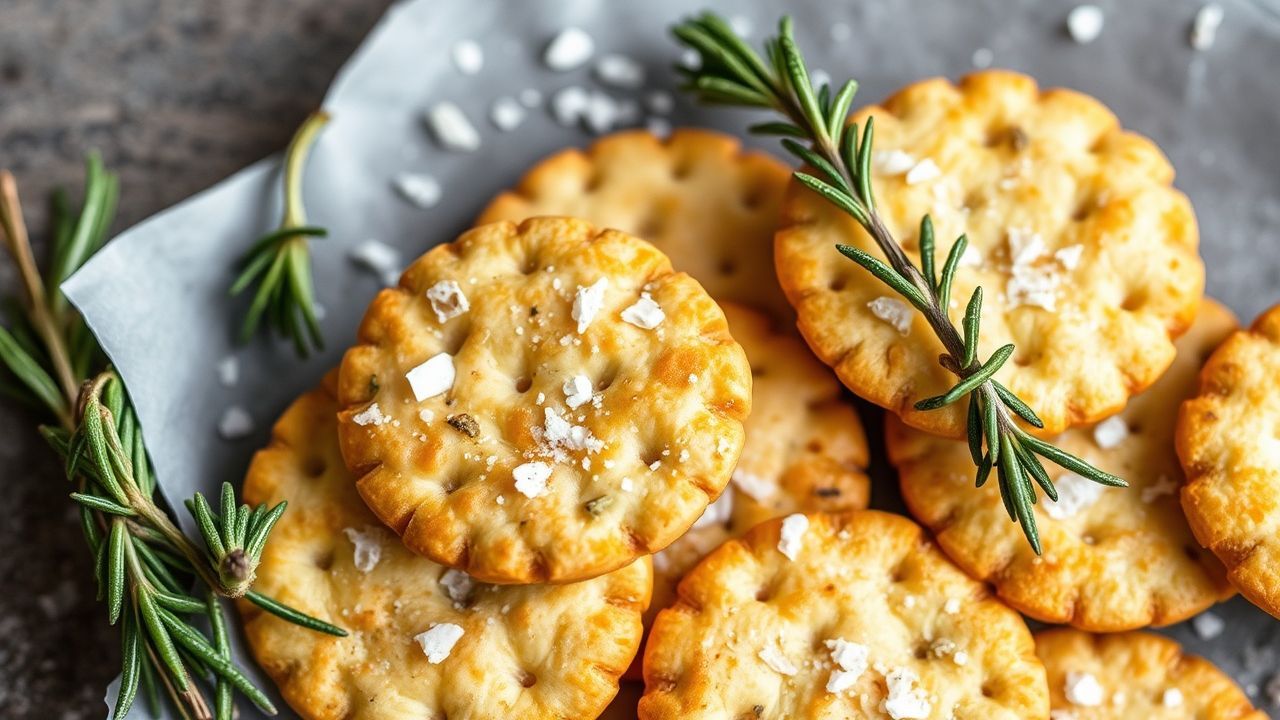

Rosemary crackers deliver a crisp, herb-forward snack that highlights fresh rosemary and flaky sea salt. These crackers reward careful rolling and confident timing, producing a snap that complements cheeses and dips.
- Make ultra-thin dough: aim for 1/16-inch for ideal snap.
- Use fresh rosemary: it yields brighter aroma than dried.
- Bake until golden: edges signal the finish rather than center color alone.
- Store airtight: they keep crisp up to two weeks at room temperature.
Prep and Cook Time
Preparation: 15 minutes. Resting time: 30 minutes. Cooking: 20–25 minutes. Total: approximately 1 hour 10 minutes.
Times assume standard home-oven performance and paper-thin rolling. Oven models vary, so watch for golden edges and firm texture rather than relying on minutes alone.
Yield and Difficulty
Makes: about 40 crackers depending on shape and thickness.
Difficulty: Medium. Mastering rosemary crackers focuses on consistent thickness and close visual checks while baking.
Ingredients for Rosemary crackers
Keep ingredients simple and measure precisely for consistent texture. Use fresh pantry staples and a high-quality olive oil for better browning and mouthfeel.
Key components include a starch base, fat to interrupt gluten, fresh herb for aromatic lift, and just enough water to bind without making the dough sticky.
- 1 ½ cups all-purpose flour, sifted
- ½ teaspoon baking powder
- 1 teaspoon fine sea salt, plus extra for sprinkling
- 2 teaspoons fresh rosemary, finely chopped — fresh rosemary gives clearer top notes than dried. See rosemary
- 5 tablespoons extra-virgin olive oil — fat choice affects mouthfeel and browning. Reference: olive oil
- ½ cup cold water, more if needed
- Optional: a pinch of freshly ground black pepper or smoked paprika for warmth
Instructions for Rosemary crackers
Work methodically: measure, mix, rest, roll, and bake. Each step influences crispness and flavor distribution.
Follow the sequence to avoid overworking the dough; minimal handling produces crackers that snap rather than chew.
Step-by-step
- Preheat oven to 350°F (175°C). Line a baking sheet with parchment paper.
- In a bowl, whisk sifted flour, baking powder, and 1 teaspoon sea salt until even.
- Add finely chopped fresh rosemary and rub between fingertips to release oils into the flour for better aroma.
- Pour in extra-virgin olive oil and work it with fingers or a pastry cutter until the blend resembles coarse crumbs.
- Drizzle cold water gradually while stirring with a fork until a firm dough forms. Add water a teaspoon at a time if needed. Stop as soon as dough holds together.
- Turn dough onto a lightly floured surface and roll out very thin—target about 1/16 inch. Thin dough equals crisp texture; thicker dough yields a biscuit-like bite.
- Trim edges and cut into uniform squares or rectangles—roughly 2 inches each side—for even baking.
- Place pieces on parchment-lined sheet, prick each lightly with a fork to prevent puffing, and sprinkle lightly with sea salt.
- Bake 20–25 minutes, watching for golden edges and firm centers. Rotate the tray halfway for even color.
- Cool completely on a wire rack; the crackers firm as they cool and reach optimum crunch.
Key Technique Notes for Rosemary crackers
Rolling thickness and even cutting determine the final snap and presentation. Consistent shapes bake uniformly and feel professional.
Use the fork-pricking step to vent steam and prevent blisters. If you use a convection oven, reduce temperature by 15–20°F and check earlier.
Tips for Rosemary crackers
Freshness and balance matter: fresh rosemary, quality olive oil, and the correct water ratio yield crisp, flavorful crackers. Distribute the chopped herb evenly to avoid concentrated bites.
Work quickly when incorporating fats to avoid warming the dough. Cooler dough rolls thinner and breaks with a clean fracture after baking.
- Fresh rosemary: chop fine and distribute evenly so you don’t get concentrated pockets of herb.
- Gluten-free option: use a blend of almond and rice flours; expect a slightly different texture and adjust water gradually.
- Edge finishing: a pizza cutter gives sharp edges and a professional look.
- Flavor variations: add lemon zest for brightness or grated hard cheese for savory depth.
Baking Troubleshooting for Rosemary crackers
If crackers come out soft, they likely need more baking time or thinner rolling. Small increments—2–3 minutes—prevent burning while improving crispness.
Uneven browning suggests hot spots in your oven; rotate trays and test placement to find the most consistent shelf position.
Serving Rosemary crackers
These rosemary and sea salt crackers pair well with soft goat cheeses, hummus, and aged reductions. Their herbal lift complements fatty or tangy companions.
For an appealing board, arrange crackers beside dried fruits, olives, and roasted nuts. They also garnish soups and salads when crumbled into coarse crumbs.
Explore related snack ideas on the site: see our tag collection at Rosemary crackers tag and browse seasonal recipes on the homepage at CookHarvest home.
Nutritional Info
One cracker (approx. 10 g) contains roughly 45 calories, 1 g protein, 5 g carbohydrates, and 2.5 g fat. Values vary with ingredient substitutions.
Use whole-grain flours or seed blends to boost fiber and micronutrients, but expect a denser crumb and slightly different bake time.
| Nutritional Info (Per Serving) | Calories | Protein | Carbs | Fat |
|---|---|---|---|---|
| One cracker (approx. 10g) | 45 | 1g | 5g | 2.5g |
Q&A
Readers often ask about herb choices, storage, and texture control. Short, practical answers help you replicate success at home.
Below are concise answers to common questions that arise when crafting these crackers.
Q1: What makes rosemary and sea salt a classic pairing?
Rosemary contributes a piney, resinous aroma that contrasts the clean minerality of sea salt. Together they produce a balanced flavor profile that enhances simple baked starches.
Q2: How thin should I roll the dough for the best snap?
Target about 1/16 inch for thin, crisp crackers. Even rolling avoids thick centers that remain chewy after intended bake time.
Q3: Can I prepare dough ahead of time?
Yes. Dough can rest wrapped in plastic in the refrigerator up to 24 hours. Bring it back to a slightly pliable temperature before rolling for consistent thickness.
Q4: Are there reliable substitutions for texture or diet needs?
Substitute gluten-free flours with a tested blend to mimic hydration and structure. Increasing fats slightly can help tenderize denser alternative flours.
Recipe Context and Food Science
Understanding the roles of each ingredient clarifies technique choices. Flour provides structure; fat interrupts gluten strands to create flakiness; water hydrates proteins and starches.
The baking powder gives a subtle lift, preventing flat toughness by creating tiny air cells. If omitted, expect a thinner, harder cracker with less delicate fracturing.
For background on the wider category and ingredient context, consult references on cracker (food), sea salt, and flour.
Final Thoughts on Rosemary crackers
Making rosemary crackers refines judgment on thickness, salt balance, and bake timing. The process trains the eye and hands for other crisp baked goods.
Practice yields repeatable results: thin, golden, herb-kissed crackers that elevate snacks and plates alike. Experiment with small batches when testing new flavor additions.
FAQ
How long do homemade rosemary and sea salt crackers stay fresh?
Stored in an airtight container at room temperature, crackers retain crispness up to two weeks. For longer storage, keep them in a sealed tin in a cool, dry place.
Can I use dried rosemary instead of fresh?
Yes, but use about half the quantity because dried herbs concentrate flavor. Chop any larger dried leaves finely to avoid tough bites.
What oven temperature is best for consistent results?
350°F (175°C) works reliably in most home ovens. If you own a convection oven, lower the temperature by 15–20°F and reduce bake time slightly.
Is there a gluten-free approach that keeps crispness?
Use a tested gluten-free flour blend and add a binder like xanthan gum if not included. Work the dough cold and roll very thin to encourage snap.
How do I prevent crackers from puffing during baking?
Prick each cracker lightly with a fork to release steam and create even texture. Also ensure uniform thickness across pieces for consistent baking.
See also: Browse related tips in the site tag Rosemary crackers.
Recommended Reading:
- Crisp & Sweet: The Ultimate Guide to Dehydrated Apple Chips
- Preserving Fresh Flavor: The Art of Putting Up Tomatoes
- Crunchy Creations: Homemade Granola Using a Dehydrator